Colocalization
Purpose
|
Colocalization analysis reports the number of marker pairs that are within a user-specified distance of each other. Colocalization can provide insights into the number of cells that are in close proximity to other cells in a separate channel, or whether a single cell is expressed in more than one channel. Colocalization can be found in the Region Data section of the Analyze ribbon. You may also use the colocalization function as you place markers in Neurolucida, Neurolucida 360, or Vesselucida 360. |
About double labeling
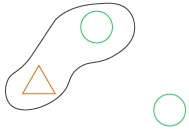
Double labeling of cells occurs when cells are imaged using two or more imaging techniques, and marked more than once. Using several imaging techniques make it possible to visualize different aspects of the cells, but depending on the imaging technique, cells may appear to be in slightly different locations.
How the colocalization analysis works
Multiple markers are considered colocalized if they are in close proximity, that is, if a sphere of a given radius (colocalization distance) placed at one marker encloses another marker.
The value for the colocalization distance should be:
- Equal to the difference in position between visualizations of the same cell.
- Smaller than the distance between different cells.
If the value is too big, distinct cells may be interpreted as a single cell.
Analysis results
Reports the number of marker pairs that are located within a user-specified distance of each other.
The results are not listed twice: if Marker 1 and Marker 2 colocalize, the number of colocalizations is only listed for Marker 1.